
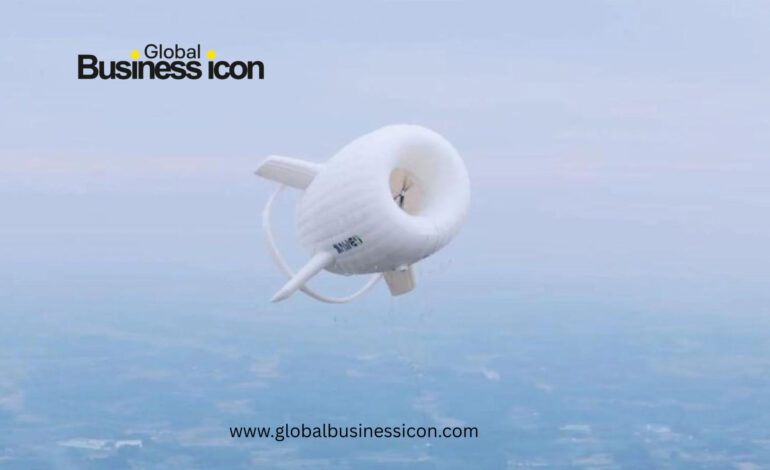
China Launches World’s First Megawatt-Class Airborne Floating Wind Turbine: A Green Energy Revolution

China has made history by launching the world’s first megawatt-level floating airborne wind turbine, the S2000. Discover how this high-altitude “airship” turbine works and what it means for the future of renewable energy.
The global race for renewable energy dominance has just taken a massive leap upward. In a groundbreaking development this week, China successfully launched and tested the S2000, the world’s first megawatt-level airborne floating wind turbine.
Unlike traditional turbines rooted in the ground or ocean floor, this revolutionary system floats thousands of meters in the sky, harnessing the powerful, consistent winds of the stratosphere.
Here is everything you need to know about this engineering marvel and why it is being called a “game-changer” for green energy.
What is the S2000 Floating Wind Turbine?
Developed by Beijing Linyi Yunchuan Energy Technology, the S2000 is technically known as a Stratospheric Airborne Wind Energy System (SAWES). Visually, it resembles a massive, futuristic airship or blimp rather than a standard windmill.
During its maiden flight in Sichuan Province, the system:
- Ascended to an altitude of 2,000 meters (approx. 6,500 feet).
- Generated electricity utilizing high-altitude winds.
- Successfully fed power into the local grid, marking a historic first for a system of this size.
While smaller airborne turbines have been tested before, the S2000 is the first to reach the megawatt-class capacity, making it a commercially viable power source rather than just an experiment.
How Does It Work?
The concept behind the S2000 is ingenious in its simplicity and efficiency.
- Helium Buoyancy: The main structure is a helium-filled aerostat (airship) that lifts the entire system into the sky without consuming fuel.
- Harnessing High-Altitude Winds: Winds at 2,000+ meters are significantly stronger and more stable than those at ground level. This allows the S2000 to generate power consistently, even when the air on the ground is still.
- Power Transmission: The electricity generated by the onboard turbines is transmitted down to a ground station via a high-strength, ultra-lightweight tether cable.
Why “Airborne” Floating Wind is the Future
This innovation solves several critical problems facing the traditional wind energy sector:
1. No Land Required
Traditional wind farms require vast amounts of land or expensive offshore infrastructure. The S2000 floats above the ground, meaning it can be deployed over forests, rugged terrain, or even remote islands without disturbing the landscape.
2. Higher Efficiency
Because high-altitude winds are continuous, the S2000 can operate at a much higher capacity factor than ground turbines. Reports indicate it could potentially generate 3 to 5 times more energy than a conventional turbine of the same size.
3. Rapid Deployment
Designed to be portable, the system can be transported in shipping containers and inflated/deployed in a matter of hours. This makes it an ideal solution for disaster relief zones, military outposts, or remote mining operations that need immediate power.
The Global Impact of China’s Wind Tech
With the launch of the S2000, China has solidified its position as a leader in “deep green” technology. This move complements their existing dominance in offshore ocean wind farms, creating a dual-threat approach to renewable energy: dominating both the deep blue sea and the high blue sky.
As the technology matures, we can expect to see fleets of these “floating power plants” dotting the skies, providing clean, silent, and efficient energy to cities around the world.